
Provo City Directory Collections
Provo Library’s Special Collections gives the city directory search a firm local base. The earliest listed item is the 1884 Utah Gazetteer and Directory of Logan, Ogden, Provo, and Salt Lake Cities. It has 634 pages and the call number 917.92 Ut1 1884. The Polk’s Provo City and Utah County run begins with 1917–18 and continues through 2004-present, with gaps that should be recorded rather than silently filled.
| Collection | Local Years | Where Held | Access and use |
|---|---|---|---|
| Sloan & Dunbar, Herald Printing | 1884 | Provo Library | Early names, work, and addresses |
| R.L. Polk & Co. | 1917–18; 1920; 1922; 1926; 1929; 1930–31; 1935–36; 1939; 1941; 1944; 1946; 1950; 1953 | Special Collections | Year snapshots and occupations |
| Later Polk volumes | 1955–62; 1964–65; 1967–80; 1982–85; 1987; 1996; 1998; 2000–02; 2004-present | Special Collections | Current and past editions with gaps |
| 1904–05 Polk scans | 1904–05 | Digital genealogy and library copies | Entry format and street guide |
The table is a coverage aid, not a claim that every year has the same pages or index. A missing volume can reflect a gap in the local holding, a publication break, or a search boundary. Save the exact edition and page image whenever possible.
The Provo Library holdings page identifies the local city directory collections and call numbers.
1884 Provo City Directory
The 1884 Utah Gazetteer and Directory predates Provo’s 1902 street renaming and numbering change. Its value is not just the names. It preserves an early address system, work roles, business places, and the way a commercial directory grouped several Utah cities. Use the call number and page reference in a research note so another reader can return to the same volume.
Early directory evidence must be read as a publication snapshot. A name may be absent because the person was not listed, the spelling differs, the volume had a coverage rule, or the household was outside the publisher’s reach. Compare an address with a deed, plat, map, newspaper, or later directory before translating it into a modern Provo location.
The Provo Library historic-Provo collection page provides the local-history setting for older city directory work.
Reading a Provo City Directory
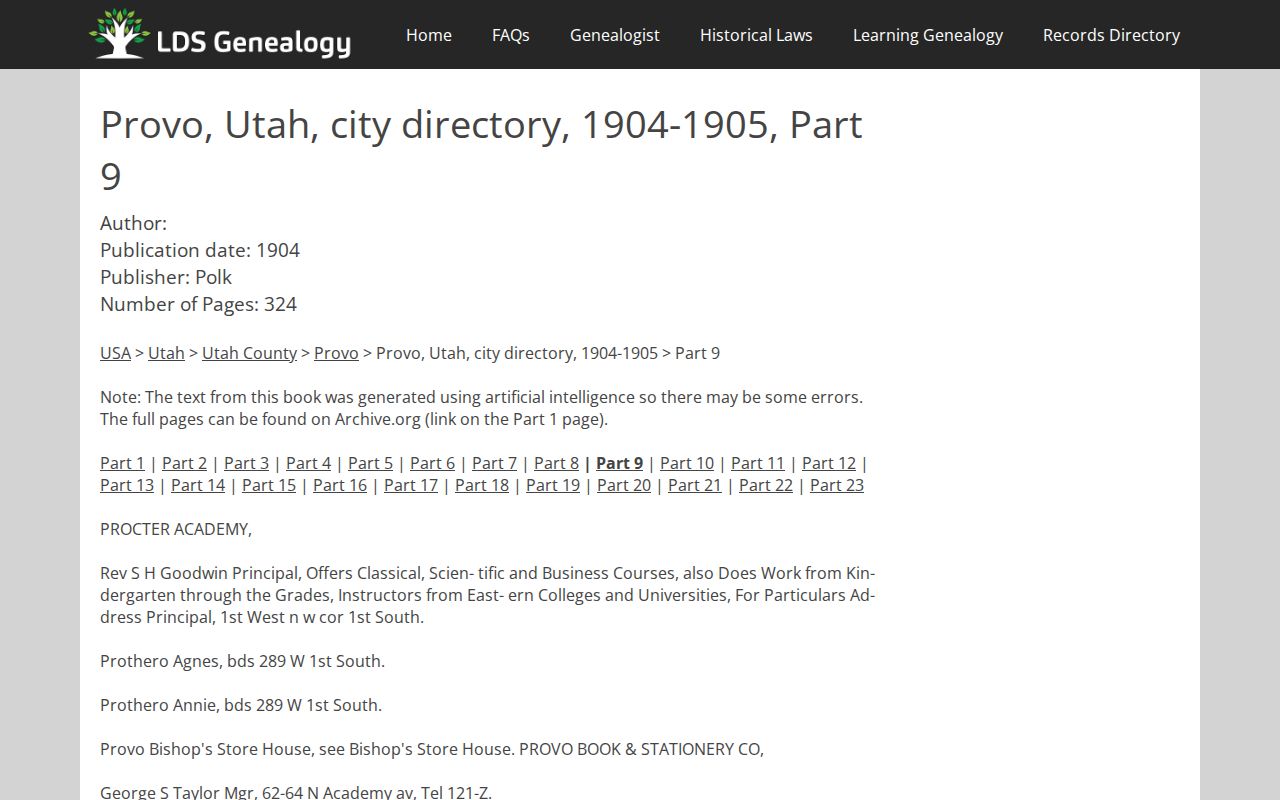
The digitized 1904–05 volume shows a practical pattern: surname and given name, occupation or role, employer or organization, residence or business address, phone or reference when present, and cross-reference. It also separates business entries from personal residence entries. An entry can say a person boards at one place, works at another, or has a shop and a home at different addresses.
| Name | Surname and given name, sometimes initials or a spouse reference |
|---|---|
| Work | Occupation, employer, organization, or business role |
| Address | Residence or business location, with the original street form |
| Mark | Printed abbreviations such as bds for boards and res for resides |
| Cross-reference | “See” entry directing the reader to another spelling or listing |
Keep the printed abbreviation until another record supports an expansion. The 1904–05 pages include examples such as a teacher with a residence, a grocer with a store and separate residence, and a person directed to another surname. Those distinctions are central to reading a city directory without turning a work address into a home address.
The digitized 1904–05 Provo directory page shows the actual name, role, address, and cross-reference layout.
Provo City Directory Terms
Historical city directory language is compact. A householder index generally centers on the person or household head chosen by the publisher. A criss-cross section works from an address or street order toward names. Provo’s library page does not establish a complete dedicated reverse-directory run, so address-first scanning should be described as a method with possible gaps.
- Criss-cross directory
- An address-order list that can connect a street location to a name.
- Householder index
- A publisher’s name-based or household-centered finding aid.
- Abbreviation key
- The page or section that explains short marks such as bds and res.
- Entry
- The printed line or block for a person, business, household, or organization.
Photograph or note the abbreviation key before copying entries. Then capture title, publisher, edition, page, exact spelling, address, role, and any “see” reference. A city directory search becomes much easier to audit when the original wording remains visible.
Tracing Provo City Directory Years
A useful family-history workflow follows a person across editions, not just across search boxes. Start with a year that fits the person’s known life. Follow the same name and address forward, then check whether a spouse, occupation, or street change supplies a second anchor. Pair a directory year with a federal census year when available under the federal 72-year release rule. Use deeds, newspapers, permits, and obituaries to bridge the years that the library does not hold.
- Choose the nearest directory year and record the full citation.
- Search the alphabetic name list, then test spelling variants and “see” references.
- Copy occupation, employer, residence, business address, and printed marks.
- Scan the street-order section or criss-cross pages for nearby entries.
- Compare the next available edition and close the trail with a newspaper, cemetery, deed, or archive source.
Disappearing from one edition does not prove a move or death. The person may be unlisted, the volume may have a gap, or the name may be printed under a spouse or new spelling. A directory is a strong lead when paired with time and place.
Provo City Directory Address Changes
Provo’s 1902 system change can break a literal city directory lookup. Lettered north and south streets and numbered east and west streets moved to the current system. Old J Street became Academy Avenue, now University Avenue. The 1904–05 guide uses Academy Avenue and Center Street as its starting point, and it warns that streets were renamed and given a new numbering system.
Translate only as a working hypothesis. Check the guide, historic map, recorder legal description, parcel geometry, and a later edition. The same person can appear to move when the street name changed beneath the entry. The old address is part of the evidence, not an error to erase.
The Utah State Archives research interface provides the archive-search route used alongside older directory addresses.

Provo City Directory Newspapers
Provo Library’s newspaper and obituary resources add a useful endpoint to a city directory trail. The Utah County Obituary Index contains about 20,000 entries and generally returns newspaper title and date rather than guaranteed obituary text. Microfilm is in the Rogers Wing, with out-of-area requests supported. Scans or prints are listed at $0.10 black and white and $0.40 color.
Search the cited issue and nearby dates. A second notice, correction, funeral detail, or family name may supply the anchor that a directory lacks. Provo Cemetery’s searchable map and original Sexton records provide another check. Keep the index citation separate from the full newspaper article, because they are different records.
The Provo Library obituary and cemetery page explains the index, microfilm, and request route.
Digitized Provo City Directories
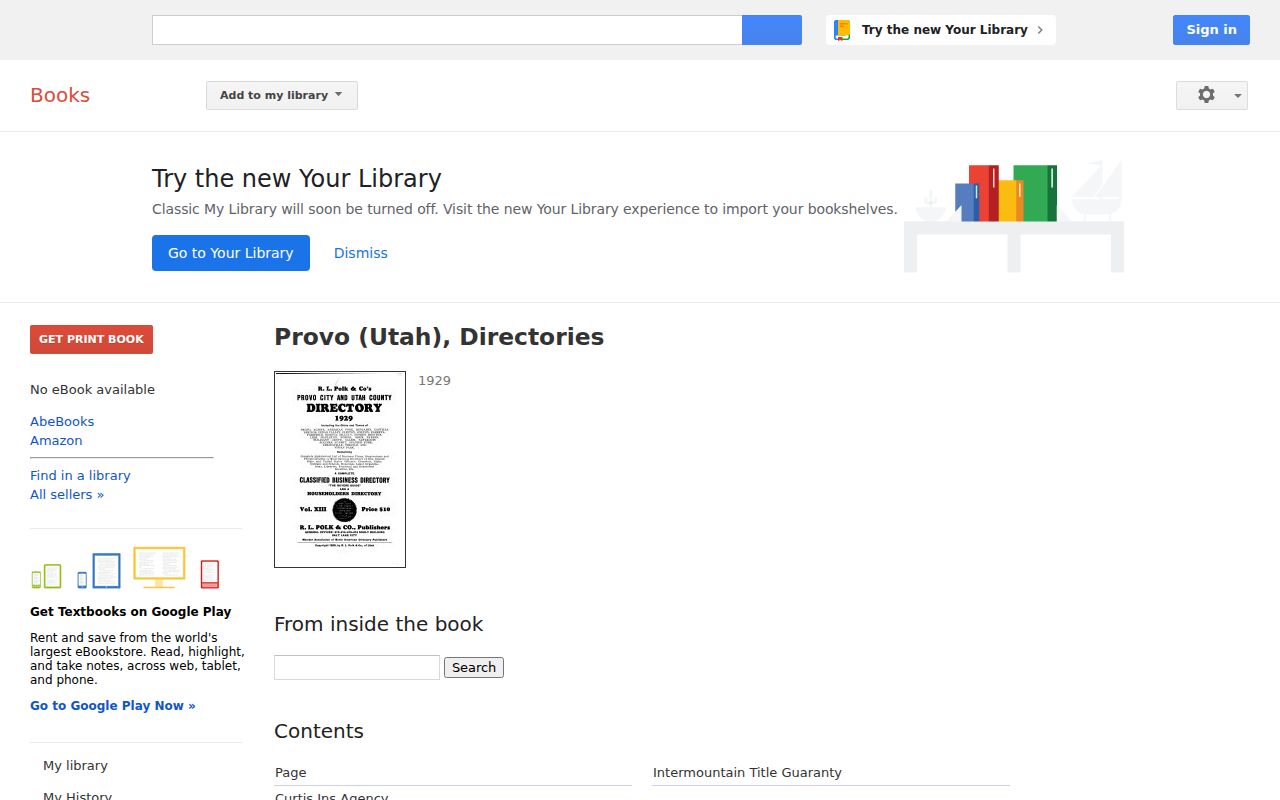
Some Provo directory pages are available through genealogy scans and Google Books, but viewability and image rights differ by edition. A Google Books item identifies a 1929 Provo Utah Directories volume and related years in its metadata, while the 1904–05 genealogy pages show actual entries. Treat a snippet or catalog record as a discovery aid until the page image and edition are confirmed.
State Archives research adds series descriptions, search type, site, keyword, date, and digital-collection fields. Historical court books are often browseable by year and volume instead of searchable by name. The archive collection begins in 1850, but arrangement controls completeness. Save the collection title and series, not only a search-result phrase.
The 1929 Provo directory item shows the edition-level discovery route for digitized city directories.
Provo City Directory Shelf Rules
An oral-history account says the city directories are kept in a locked cabinet at the library’s northwest corner. A key and two- or four-hour viewing intervals are part of that account. Confirm current Special Collections rules and access hours before relying on it. The physical shelf may hold the missing year that an online search cannot find.
For each city directory entry, save the edition, publisher, page or image, spelling, occupation, employer, residence, business address, cross-reference, and next-year comparison. A three-source minimum is a sound historical check: one directory, one newspaper, obituary, cemetery, or archive record, and one address, parcel, deed, or plat source.